Task 7 / 8 — Deployment Architecture Decision (for review)¶
Status: Implemented and running at http://192.168.137.10/ Scope: How we deploy the backend (Task 7) and frontend (Task 8) onto the Pi cluster Author: (Tasks 7–9)
This document describes the architecture as built. All open questions from the original proposal have been resolved — see §9 for the decisions made.
1. TL;DR¶
Deploy the backend and frontend as Docker containers on a lightweight Kubernetes cluster (k3s), following the official course architecture diagram (§3): the frontend on the master, a backend replica on the master and on every one of the 8 workers, MinIO distributed across the workers for evidence images, and PostgreSQL on the master for event metadata. This satisfies every Task 7 keyword (Docker, k3s, scalable, high-availability, distributed file system) while leaving the existing MPI / NFS / monitoring stack untouched.
The main thing I want a second opinion on: how much high availability is worth the effort for a demo — specifically whether we accept the master node as a single point of failure (simplest) or invest in a 3-server HA control plane (a lot more work) — plus whether co-locating backend + MinIO on the RAM-tight workers is OK.
2. What Task 7 actually requires¶
From the project brief:
Task 7 (backend): "The backend can be deployed as Docker container(s) on a Raspberry Pi Kubernetes cluster with k3s … a robust and scalable high availability cluster of Raspberry Pi 3 nodes. The cluster includes a distributed file system (e.g. Ceph + S3 gateway) or a storage service (e.g. SeaweedFS or MinIO)."
Task 8 (frontend): "The frontend will also be deployed as a Docker container on a Raspberry Pi Kubernetes cluster with k3s or a similar solution… Use REST or MQTT for communication between components."
Keywords we must hit: Docker containers · k3s · scalable · high availability · distributed file system.
3. The authoritative topology (course diagram)¶
This is the official architecture from the course page — it's our source of truth:
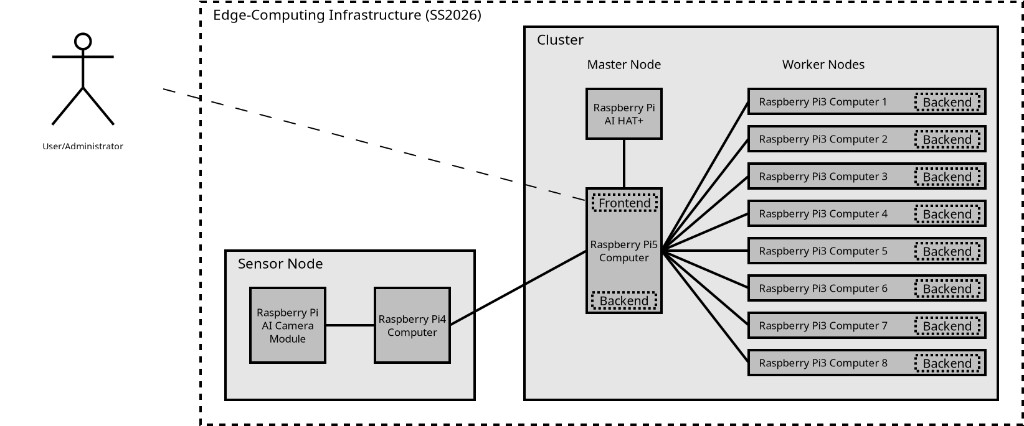
What the diagram dictates:
- Frontend runs on the master (Pi 5).
- A Backend runs on the master and on every worker (Pi3 1–8) — i.e. the workers are the scalable / high-availability backend tier. (This is the official answer to "do we need backend replicas?" — yes, one per worker.)
- The User / Administrator reaches the frontend on the master.
- The sensor node (Pi 4 + AI Camera Module) feeds the master.
- The master also carries a Pi AI HAT+ accelerator.
The diagram is a component view — it deliberately doesn't draw the database or storage. Section 4 shows how we realize it concretely on k3s (where MinIO and Postgres go).
4. Cluster state before k3s (the gap that was closed)¶
Before this deployment, the cluster was a classic HPC setup, not a Kubernetes one:
| Node | Hardware | Currently runs |
|---|---|---|
master (192.168.137.10) |
Pi 5, 8 GB, aarch64, Debian 13, + AI HAT+ | Docker Compose monitoring (Grafana/Prometheus/Alertmanager), PostgreSQL, single-node MinIO, Flask backend (server.py, as a process), dnsmasq (cluster DHCP/DNS), NFS export |
worker1–8 (.101–.108) |
Pi 3, ~900 MB, aarch64, Debian 13 | MPI compute (HPL, Amdahl/Gustafson), NFS clients, node_exporter. No Docker, no k3s. |
sensor (192.168.137.20) |
Pi 4 + AI Camera Module | Detection model, pushes events to the backend |
The gap (now closed): the brief + diagram assumed a k3s cluster with a backend on every node and distributed storage; we had MPI + NFS + a single-node Docker stack on the master. This deployment closed that gap without disturbing the compute/monitoring work (Tasks 2–5).
Preflight confirmed all nodes are aarch64 / 64-bit, so standard ARM container images (MinIO, nginx, etc.) will run — this was the main blocker and it's clear.
5. Proposed realization on k3s¶
We map the diagram onto k3s, adding distributed MinIO (the Task 7 "distributed file system") co-located on the workers and keeping PostgreSQL on the master:
flowchart TB
  user["User / Administrator"] -->|HTTP :80| traefik["Traefik ingress (master)"]
  sensor["Sensor (Pi 4 + AI camera)"] -->|REST events| traefik

  subgraph master["master — Pi 5 (8 GB) + AI HAT+"]
    traefik --> fe["Frontend pod (nginx + React)"]
    traefik --> svc["Backend Service (load-balanced)"]
    svc --> bem["Backend pod"]
    bem --> pg[("PostgreSQL — metadata")]
    k3ss["k3s server (control plane)"]
  end

  subgraph workers["worker1–8 — Pi 3 (~900 MB each)"]
    bw1["Backend + MinIO"]
    bw2["Backend + MinIO"]
    bw3["Backend + MinIO"]
    bw8["Backend + MinIO (×8 total)"]
  end

  svc --> bw1
  svc --> bw2
  svc --> bw8
  bem -->|"S3 (images)"| bw1
  bw1 -. "erasure-coded shards" .- bw2 -. "across all 8" .- bw8
  bw1 --> pg
Component placement:
| Component | Where | Why |
|---|---|---|
| k3s server (control plane) | master | Only node with RAM headroom (8 GB) |
| k3s agents | all 8 workers | Make them part of the cluster (~300 MB each) |
| Backend (Flask) | master + all 8 workers, one replica each | Per the course diagram; load-balanced by a Service |
| Distributed MinIO (8-node, EC:4) | worker1–8 (co-located with backend) | The "distributed file system" — images sharded across all workers |
| Frontend (nginx + React build) | master | Served via Traefik at http://192.168.137.10/ |
| PostgreSQL | master (existing Compose) | Event metadata; no migration needed |
Local image registry (registry:2) |
master | k3s pulls our built images from here |
Untouched: the Task 5 monitoring Compose stack, MPI, NFS, and dnsmasq all keep running as-is. k3s uses its own bundled containerd, so it coexists with Docker on the master.
6. Why a backend on every worker?¶
The backend (server.py) is the single component everything talks to: the sensor
pushes detections to it, the frontend reads events from it, the Telegram bot fires
from it. As one instance, if it dies the whole system's API goes dark — no event ingestion,
no dashboard, no alerts.
The course diagram puts a Backend on every worker, so multiple replicas behind a k3s Service (which load-balances across them) are the intended design, not an add-on. That buys us:
| Benefit | What it means in practice |
|---|---|
| High availability | A worker (and its backend replica) dies → the Service routes to the others. No outage. |
| Self-healing | k3s restarts a dead pod automatically (vs. SSH-ing in to restart a process). |
| Scalability | Request load (sensor pushes + dashboard polling) spreads across replicas. |
| Zero-downtime updates | Rolling deploys — new version comes up before the old one goes down. |
Important precondition: replicas only work if the backend is stateless — all state must live in Postgres + MinIO, never on a pod's local disk. Our backend already does this (events → Postgres, images → MinIO), so it's safe to replicate.
What this gives us, and the remaining gap: because a backend runs on every worker, we get genuine node-level HA for the API. The remaining single point of failure is the master (it holds Postgres, the ingress, and the frontend), which the worker replicas don't protect against — see Q1. The only real cost of backend-on-every-worker is RAM on the 900 MB Pi 3s, where each backend pod (~80 MB) sits alongside MinIO — see Q2.
7. Failure scenarios — what happens if a node goes down?¶
Assumes MinIO EC:4 across 8 workers (each image = 4 data + 4 parity shards), with a backend replica on each worker.
| Scenario | Impact | Recovery |
|---|---|---|
| 1–3 workers down | Fully operational. Images still readable and writable; the lost backend replicas just drop out of the Service (it routes to the rest); k3s reschedules where it can. | Node returns → MinIO auto-heals the missing shards; replica rejoins. Automatic. |
| 4 workers down | Images still readable (EC:4 tolerates 4 lost shards); new image writes pause (write quorum 5/8). Backend still served by remaining replicas. No data loss. | Bring any one node back → writes resume + auto-heal. |
| 5+ workers down | MinIO unavailable; data loss only if more than 4 are permanently destroyed (dead SD card). Metadata in Postgres unaffected. | Restore nodes; if ≤4 were truly lost, all images rebuild from parity. |
| A backend pod crashes | None visible — Service routes to other replicas; k3s restarts the dead pod. | Automatic. |
| Sensor (Pi 4) down | No new detections; existing events + dashboard work normally. | Restart the sensor. |
| MASTER down ⚠️ | Major outage. Control plane, PostgreSQL, frontend, ingress, and dnsmasq + NFS live here. Even though backend replicas on the workers stay alive, there's no ingress to reach them and no Postgres to serve — so the API + dashboard are down. MinIO data on the workers survives but is unreachable until the master returns. | Bring the master back; pods + Postgres reconcile. |
Takeaway: the design is genuinely resilient to worker failures (the distributed part — exactly what Task 7's "distributed file system / HA" is about). The master is the remaining single point of failure — see Q1.
8. Alternatives considered¶
| Option | Verdict |
|---|---|
| Path A: k3s + distributed MinIO (this doc) | Chosen. Matches the course diagram; hits every keyword; best demo; reversible. More setup effort. |
| Path B: Docker Compose/Swarm + distributed MinIO | Lower risk, less faithful to "k3s." Good fallback if k3s setup eats too much time. |
| MinIO on 4 workers instead of 8 | Frees RAM on the other 4, but less distribution. Backend still on all 8 (cheap). Possible compromise (Q2). |
| EC:2 instead of EC:4 | 75% usable capacity but only tolerates 2 failures. Default pick is EC:4 (50% usable, tolerates 4) — SD cards are 32 GB so capacity isn't the constraint; resilience is the better demo. |
| 3-server k3s HA control plane | True control-plane HA, removes the master SPOF — but 3× the setup/complexity. Likely overkill for a demo (Q1). |
| Ceph instead of MinIO | Brief allows it, but Ceph is far heavier on 900 MB Pi 3s. MinIO is the pragmatic, allowed choice. |
9. Decisions made (originally open questions)¶
- HA scope: Master SPOF accepted for the demo — documented as a known limitation. Worker-level HA is fully functional (backend DaemonSet + MinIO erasure coding).
- Worker RAM / co-location: Co-located backend + MinIO on all 8 workers. Stable in practice with the ~900 MB Pi 3s — no OOM issues observed during normal operation.
- MinIO parity: EC:4 chosen — tolerates up to 4 worker failures, better failure demo story. 50% usable capacity is fine with 32 GB SD cards.
- Existing data: Started MinIO fresh. The
evidencebucket is auto-created by the backend on first event. Old events keep their legacy:9000image URLs. - Timing: k3s installed alongside the running MPI/monitoring stack with no conflicts. k3s uses bundled containerd; Docker Compose monitoring continues independently.
- Fallback: Not needed — k3s setup succeeded. Path A (k3s + distributed MinIO) is live.
10. Rollback plan¶
Everything is reversible with no impact on Tasks 2–5:
k3s-uninstall.sh(master) andk3s-agent-uninstall.sh(workers) remove k3s entirely and restore the original iptables.- The monitoring Compose stack, MPI, NFS, and dnsmasq are never modified.
- Postgres stays where it is throughout.
11. Implementation steps (completed)¶
- ~~Authorized a shared SSH key across the nodes.~~
- ~~Installed k3s server on master; joined 8 agents.
kubectl get nodes= 9 Ready.~~ - ~~Stood up local registry on master (
192.168.137.10:5000); containerized backend + frontend; pushed images.~~ - ~~Deployed distributed MinIO (8-node StatefulSet, EC:4).
evidencebucket auto-created.~~ - ~~Deployed backend as DaemonSet (one pod per node, 9 total) behind a Service + Traefik. Deployed frontend as a Deployment pinned to the master.~~
- ~~Frontend uses relative URLs (
/api,/prom) via the ingress. End-to-end verified athttp://192.168.137.10/.~~
All steps complete. The system is live and serving the full Sentinel dashboard.